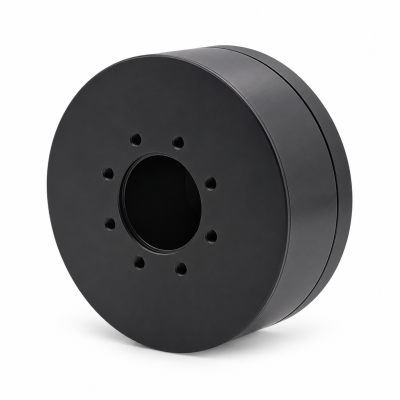
MG3505-8
 MG3505-9
 MG3505-36
 MG4315-8
 MG6010-6
 MG6010-8
 MG4305-10
 MG4310-10
 MG4310-36
 MG4310-40
 MG3510-8
 MG3510-64
 MG6010-36
 MG6010-48
 MG8108-6
 MG8108-8
 MG8108-36
 MG8108-48
 MG8115-6
 MG8115-9
 MG8115-36
 T-4024
 T-4929
 T-6034
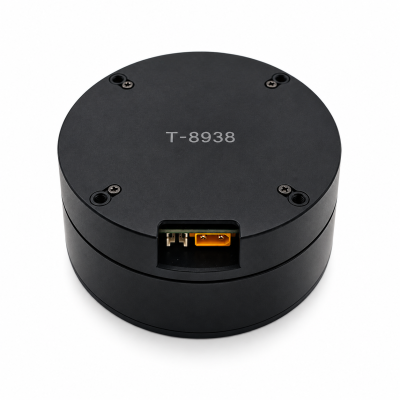
 T-8938
Continuous Torque vs Peak Torque: What Is the Difference?
SOLISMOTOR · TECHNICAL GUIDES
Continuous torque describes sustained motor capability under specified operating and thermal conditions. Peak torque describes a higher, limited-duration capability with its own current, speed and repetition limits. Both must match your application's duty cycle. If you have not yet established that cycle, start with how to calculate motor torque and speed before comparing catalog ratings.
For an OEM selection, the important question is whether the motor, drive and mechanical assembly can deliver the required torque for the required time. A larger peak number alone cannot answer it. This guide explains how to read continuous, rated and peak torque claims and turn them into a usable comparison.
Continuous, rated and peak torque are different descriptions
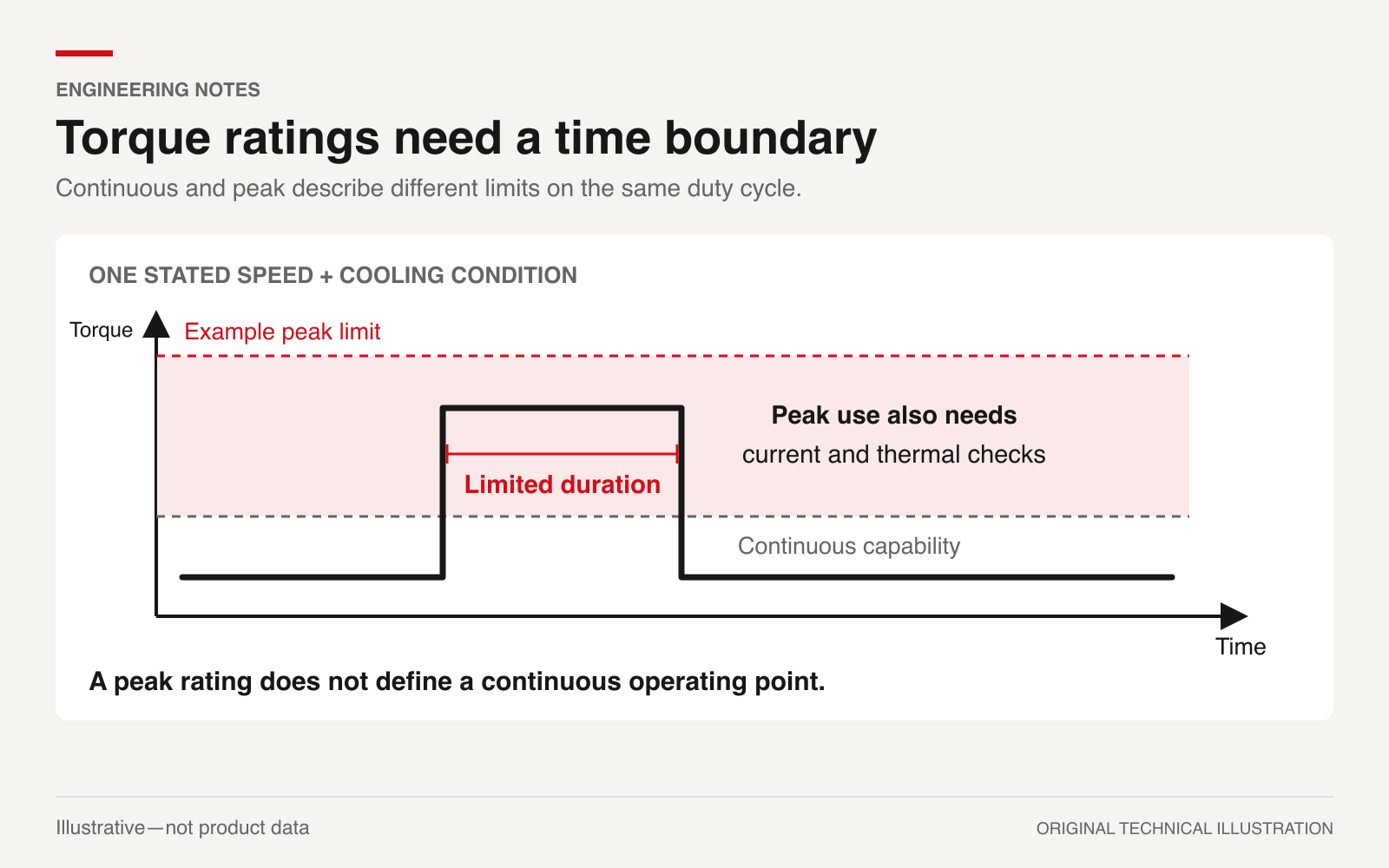
Continuous torque is the torque a motor can sustain without exceeding its specified limits when the stated speed, mounting, cooling and environmental conditions apply. It is a conditional capability, rather than a promise of the same torque at every speed or inside every enclosure.
Rated torque is the manufacturer's declared torque for a specified operating condition. In a continuous-duty specification it may identify the continuous torque at the rated operating point. However, the word “rated” alone does not tell you the duty, cooling arrangement or permissible temperature rise. Read the associated conditions.
Peak torque is the maximum torque permitted for the specified short operating interval and conditions. Establish whether the limit describes the motor, the drive or an integrated actuator. A motor's electromagnetic capability does not guarantee that the selected drive can supply the necessary current, or that a gearbox can transmit the resulting output torque.
Swipe the table horizontally to see all columns.
| Specification | What it helps you assess | What must accompany the number |
|---|---|---|
| Continuous torque | Sustained operation and thermal suitability | Applicable speed range, cooling, mounting, ambient and temperature limits |
| Rated torque | A declared operating point or duty | Rated speed, voltage, current and duty definition |
| Peak torque | Brief acceleration, braking or load demands | Allowed duration, starting temperature, current limit and repetition conditions |
| Continuous stall torque | Sustained torque at zero speed under stated conditions | Standstill rating and its thermal conditions |
| Peak stall torque | Brief torque capability at zero speed | Allowed pulse conditions; separate evidence for capability at operating speed |
Do not transfer a zero-speed rating to a moving operating point. Equally, a rated-speed value does not establish continuous holding capability at standstill.
Why the rating conditions matter
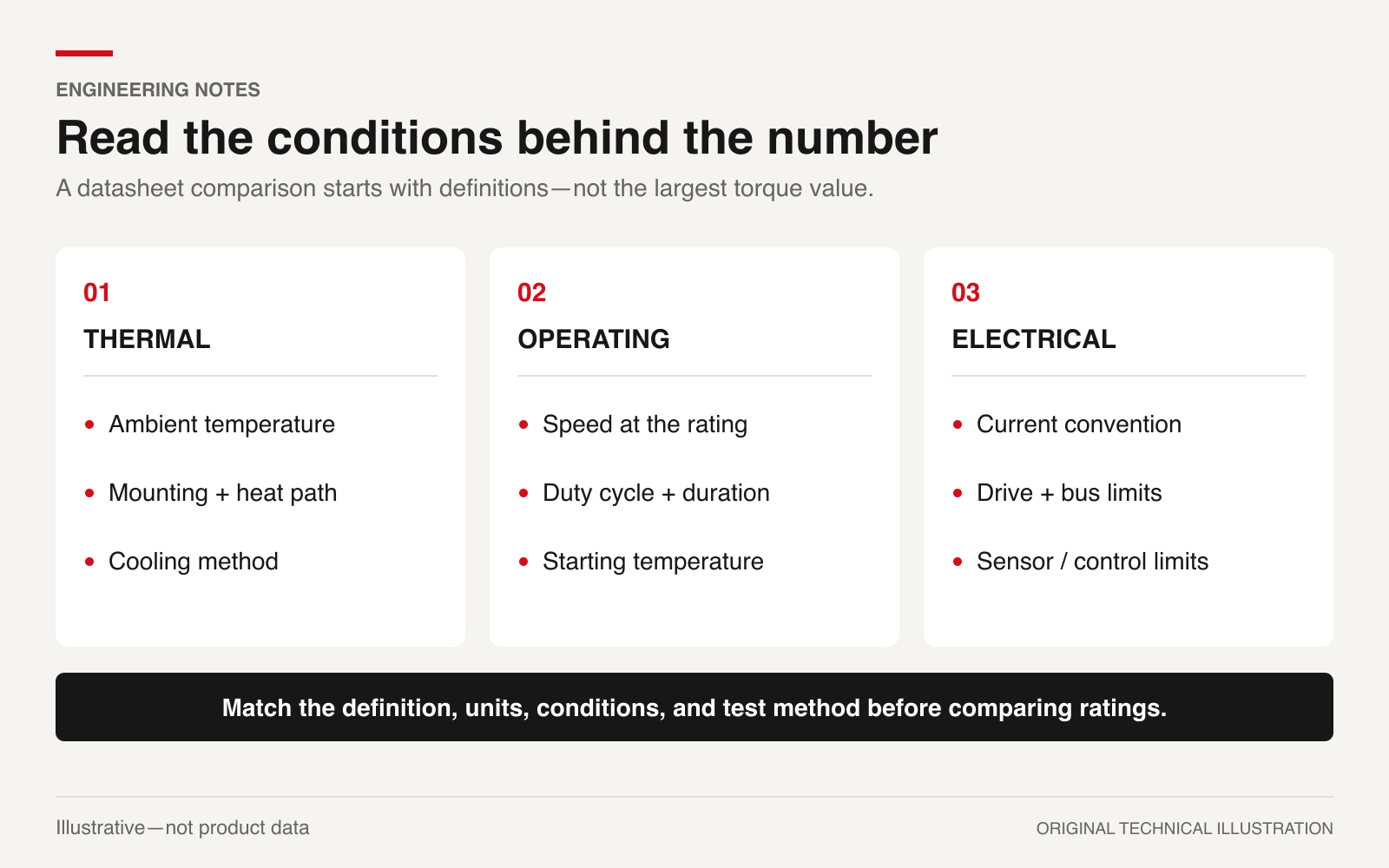
The same torque label can describe different test conditions. When reviewing two motors, place the conditions alongside the values rather than comparing only the N·m column.
The IEC 60034-1 rating and performance standard (external source) provides the relevant standards context for rotating electrical machines. IEC's current publication information also distinguishes the motor component from a complete power drive system. A motor rating should therefore not be treated as a rating for every part of an integrated axis. Citing the standard does not imply that a particular product has been tested or certified to it.
For each candidate, establish:
- Heat path: the specified mounting surface, housing or heat sink, and any required airflow or liquid cooling.
- Environment: the ambient or coolant conditions and any applicable derating.
- Operating point: the shaft speed, supply voltage and drive configuration used for the rating.
- Temperature limits: which component is limited and how its temperature is determined.
- Duty: sustained operation, a defined short run, or a repeating cycle with stated load and rest intervals.
A winding temperature limit is different from an allowable external housing temperature. Nearby electronics, feedback devices and transmission components also need their own checks. For the installation side of this question, see robot joint torque, heat and integration.
Peak torque needs a time specification
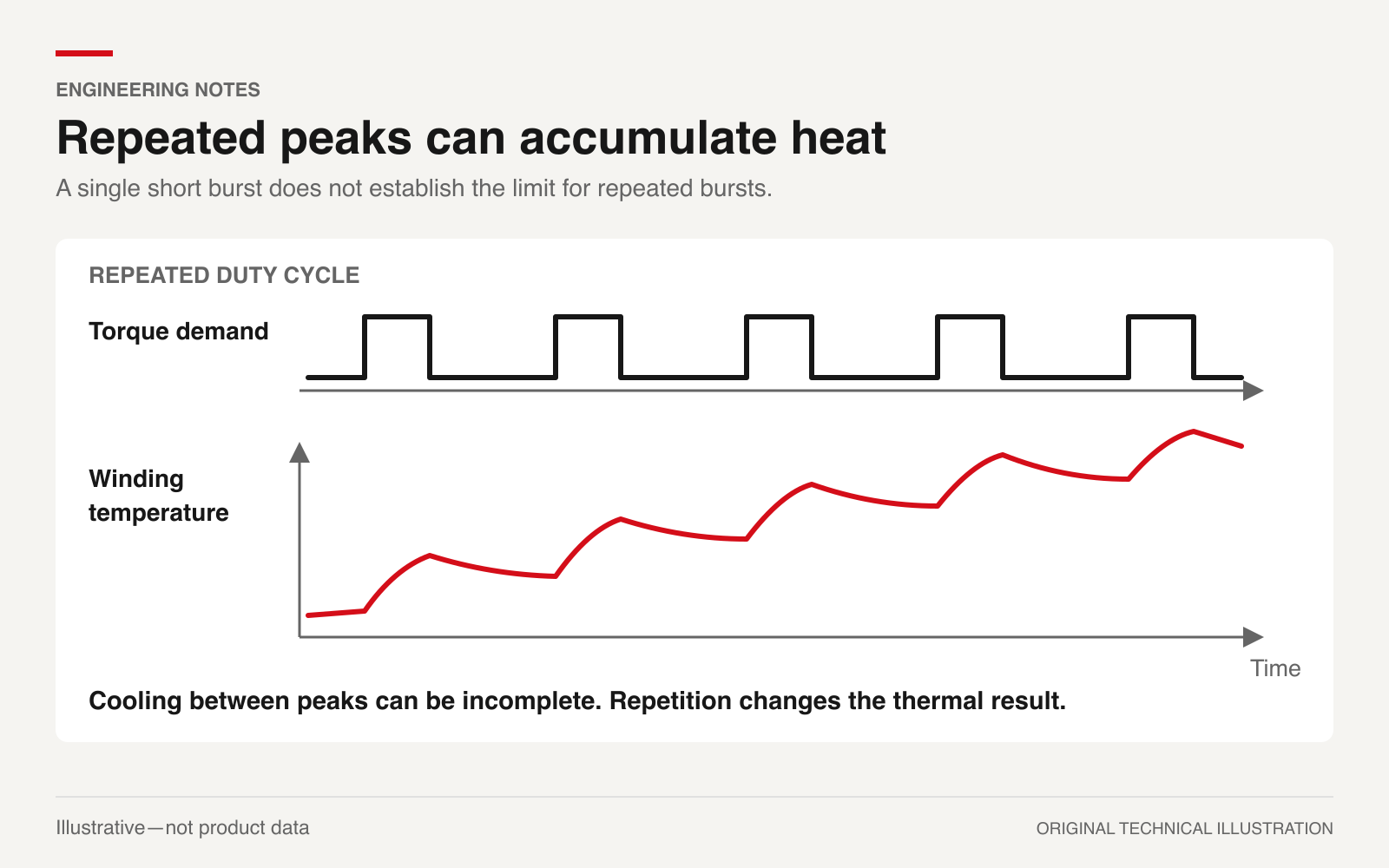
A peak torque figure without a duration is incomplete for application selection. Ask how long the requested torque is allowed, at what speed, from which initial temperature, and after what previous operating history.
This is not just a wording issue. In its aircraft motor sizing discussion, NASA's tiltwing concept study, Section 6.1.2.2 (PDF, external source) identifies substantial variation in reported peak-torque operating times and in the ratio of continuous to peak torque. That research does not establish a permitted duration or ratio for a robot joint motor; it illustrates why neither should be assumed across products.
A single burst and repeated bursts are different requirements
A motor starting cold may have a different available overload interval from one that has already been operating near its thermal limit. Repeated bursts need an agreed load-and-recovery pattern. “One second on” is still incomplete if the torque during the remaining cycle, cycle repetition and starting temperature are unknown.
For example, a hypothetical requirement of 8 N·m for 0.5 seconds once per minute is different from 8 N·m for 0.5 seconds every two seconds. Neither requirement can be accepted from an 8 N·m peak label alone. These figures describe example application demands; they are not SolisMotor specifications or suggested operating limits.
Peak torque is not an impact-load rating
A commanded acceleration pulse, an electrical braking event and an external collision can impose different loads on the assembly. Ask separately about transmission, bearing, shaft and structural limits. Peak electromagnetic torque does not establish allowable shock loading or a safety function.
Read a real product listing without filling in the gaps
The MG-H109-50 hollow-shaft servo motor page lists 4 N·m rated torque and 15 N·m peak torque. Its description also refers to the 4 N·m figure as continuous torque and states that permissible peak duration depends on the drive, power supply and thermal conditions.
Those published values help identify a candidate. They do not, by themselves, establish how long 15 N·m is available, how frequently it may repeat, or which torque-speed envelope applies in your installation. Obtain those conditions before using the peak value in a motion program. Do not derive an overload duration by dividing peak torque by rated torque, or treat the ratio as a duty-cycle allowance.
Turn the ratings into an engineering comparison
Keep all torque and speed values referred to the same shaft. For a geared actuator, distinguish motor-shaft values from transmission-output values and check the transmission's own continuous and intermittent limits.
Use the following table when comparing candidates in the Robot Joint Motor range. It is a request for application evidence, not a pass/fail result for any model.
Swipe the table horizontally to see all columns.
| Application requirement | Evidence to request | Selection question |
|---|---|---|
| Long steady load or gravity-loaded holding | Continuous capability at the actual speed, including zero speed where needed | Can this load be sustained in the intended mounting and cooling arrangement? |
| Short acceleration or deceleration | Available torque at that speed, pulse duration and motor/drive current limits | Does each demanding segment fit the permitted overload envelope? |
| Repeating moves | Full torque-speed-time cycle and applicable thermal assessment | Can the cycle repeat after warm-up without exceeding component limits? |
| High-speed motion | Torque-speed envelope at the intended voltage and drive settings | Is enough torque available at the required speed? |
| Geared output | Output-shaft ratings, transmission limits and stated conversion assumptions | Are the load and ratings being compared at the same shaft? |
| Production installation | Representative test conditions and acceptance criteria | Does the tested configuration represent the delivered assembly? |
For varying loads, cycle RMS torque can support an initial thermal comparison when its underlying torque-current and loss assumptions are appropriate. It is not the arithmetic average torque and does not replace checks on individual overload intervals or speed-dependent limits. The linked calculation guide at the start of this article develops the RMS calculation; here, the task is to check which catalog limits apply to its result.
What to put in an OEM torque requirement
Make the requirement reproducible. Record the reference shaft, torque and speed through each operating segment, segment durations, cycle repetition, holding load, supply voltage, intended drive, installation and cooling conditions. Identify the expected starting and operating temperatures and any uncertain inputs.
Then ask the supplier to confirm the continuous operating envelope, each required overload interval, the permitted repetition pattern and the validation method. SolisMotor's selection and system integration support describes assistance with torque/load/power calculations and motor, gearbox and drive matching. A defined duty profile gives that discussion a clear engineering basis.
Frequently asked questions
Is rated torque always the same as continuous torque?
Only when the specification defines it that way under the stated conditions. Confirm the duty and operating point instead of assuming the terms are interchangeable.
How many seconds can a motor deliver peak torque?
There is no universal duration. Use the limit for the exact motor and drive, operating speed, initial temperature and repetition pattern. An unspecified duration remains an open selection question.
Can peak torque hold a load continuously?
A peak label does not establish continuous holding capability. Check the standstill rating and thermal conditions for the required holding torque. A holding brake, if provided, has separate ratings and permitted uses.
Does passing an RMS torque check prove the motor is suitable?
No. Every demanded operating point still needs to satisfy torque-speed, overload-duration, drive, transmission and thermal limits. Confirm the assembled system under representative conditions before final acceptance.