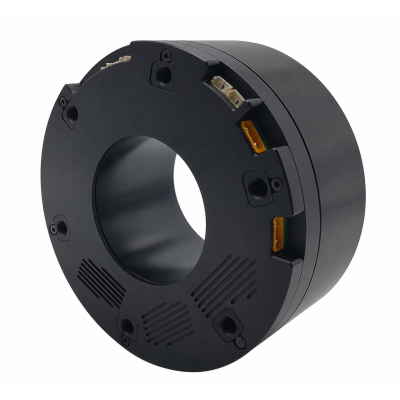
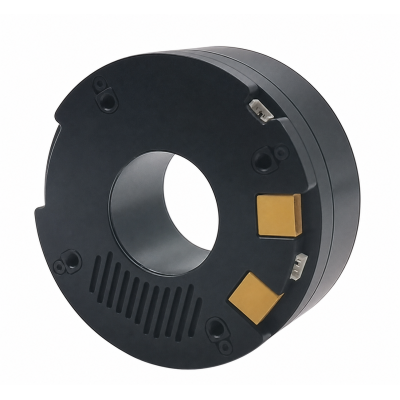
MG3505-8
 MG3505-9
 MG3505-36
 MG4315-8
 MG6010-6
 MG6010-8
 MG4305-10
 MG4310-10
 MG4310-36
 MG4310-40
 MG3510-8
 MG3510-64
 MG6010-36
 MG6010-48
 MG8108-6
 MG8108-8
 MG8108-36
 MG8108-48
 MG8115-6
 MG8115-9
 MG8115-36
 SRA705F
 SRA705FL
Incremental vs. Absolute Encoders in Robot Joint Motors: A Selection Guide
A robot joint is only as good as the feedback that controls it. The motor sets the torque; the encoder tells the controller where the joint actually is. Choose the wrong feedback type, and you inherit homing routines, position errors, or extra cost you did not need.
This guide explains how incremental and absolute encoders work in robot joint motors, where each type wins, and how to match encoder choice to your application requirements.
Why encoder choice matters in a joint motor
In an integrated joint motor, the encoder is not an accessory. It closes the control loop for position, speed, and torque, and it determines three things your design depends on.
Resolution
The smallest angular step the controller can see.
Accuracy and repeatability
How close the joint lands to the commanded position, again and again.
Startup behavior
Whether the joint knows its position the moment power comes on.
Get these right and the joint feels precise and predictable. Get them wrong and no amount of control tuning will fully compensate.
Incremental encoders: simple, fast, and position-relative
An incremental encoder outputs pulses as the shaft rotates. The controller counts those pulses to track movement and derives speed from their frequency.
Strengths
- Simple, mature technology with low cost per unit.
- High resolution at high speed, excellent for velocity control.
- Fast response, well suited to dynamic motion.
Limits
- No absolute position at startup. The joint must move to a reference point to establish its zero, which adds a homing step to every power-up.
- Position can be lost if power drops or noise corrupts the count.
- Multi-turn range requires battery backup or mechanical counters.
Incremental encoders remain a solid choice for cost-sensitive, high-speed axes where homing is acceptable and the joint does not need to know its position at power-on.
Absolute encoders: position known at power-on
An absolute encoder reports a unique position value for every shaft angle, so the controller knows exactly where the joint is the instant it powers up, with no homing and no reference move.
Single-turn absolute encoders cover one full revolution, which is what most robot joints need. Multi-turn versions add revolution counting, typically for mechanisms that rotate many turns.
Strengths
- Absolute position immediately on power-up, eliminating homing routines.
- No position loss after power interruption.
- Robust against count loss from electrical noise.
- Higher accuracy and repeatability for precision positioning.
Limits
- Higher cost than incremental feedback, especially at high bit depths.
- Slightly more complex interfaces and configuration.
For robot joints that must wake up ready to move, absolute feedback is usually the right default.
Why dual-encoder feedback is worth it on a joint
In a geared joint, the motor-side encoder cannot see what the output shaft is actually doing. Backlash, flexspline deflection, and thermal drift all sit between the two. A second encoder on the output shaft measures the real joint angle, so the controller can compensate for transmission error instead of trusting it.
This is why dual-encoder support matters on precision joint motors: it turns a good transmission into a high-accuracy joint. For direct drive joints, a single absolute encoder can be sufficient because there is no gear train between motor and load.
Head-to-head comparison
The table below summarizes the practical differences between the two feedback types on a robot joint.
| Consideration | Incremental encoder | Absolute encoder |
|---|---|---|
| Position at power-on | Unknown, needs homing | Known immediately |
| Resolution | High, especially at speed | High, up to 20-bit and beyond |
| Cost | Lower | Higher |
| Interface complexity | Simpler | More complex |
| Noise robustness | Vulnerable to count loss | Robust |
| Best fit | Cost-sensitive, high-speed axes | Joints that must be ready at power-on |
How to choose
Choose incremental when the axis runs fast, cost is the deciding factor, and a homing routine at startup is acceptable.
Choose single-turn absolute for most robot joints that must know their position at power-on and need high repeatability.
Choose multi-turn absolute for joints that rotate through many revolutions and must retain absolute position across power cycles.
Choose dual-encoder feedback on geared joints where output-shaft accuracy matters more than saving one encoder.
Match the encoder to the motor, not the datasheet alone
Resolution is not the same as accuracy. A 20-bit encoder gives around 0.00034 degrees of resolution in theory, but real joint accuracy also depends on mechanical stiffness, bearing play, calibration, and transmission error. Specify resolution for smooth control, and specify the whole actuator, meaning motor, encoder, and mechanics together, for accuracy.
Solis Motor designs joint motors, hollow-shaft motors, and servo motors with optional 16-bit and 20-bit absolute encoders and dual-encoder support, so you can match feedback to your joint architecture instead of working around it. If you are selecting a joint motor for a new robot design, contact our engineering team to discuss your resolution, accuracy, and interface requirements.
Right feedback is what makes a good joint feel effortless.