MG3505-8
 MG3505-9
 MG3505-36
 MG4315-8
 MG6010-6
 MG6010-8
 MG4305-10
 MG4310-10
 MG4310-36
 MG4310-40
 MG3510-8
 MG3510-64
 MG6010-36
 MG6010-48
 MG8108-6
 MG8108-8
 MG8108-36
 MG8108-48
 MG8115-6
 MG8115-9
 MG8115-36
 SRA705F
 SRA705FL
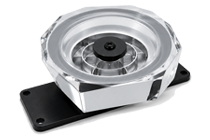
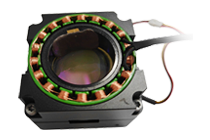
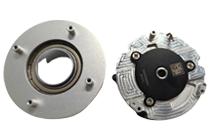
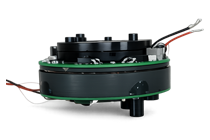
How to Select the Right Robot Joint Motor: Key Selection Criteria
How to Select the Right Robot Joint Motor: Key Selection Criteria
Robot joint motors are the heart of every robotic arm, humanoid platform, exoskeleton, and collaborative robot. Unlike ordinary industrial motors, a joint motor must combine high torque density, precise position feedback, compact geometry, and reliable closed-loop control inside a very limited space. Choosing the wrong motor usually means reworking the entire mechanical design, so it pays to evaluate a few core criteria before you commit to a model.
The short version
Define your torque and speed profile first, then match encoder resolution, hollow-shaft routing, communication interface, protection rating, and integration form factor. Always verify the continuous and peak torque against your real duty cycle instead of comparing datasheets by peak numbers alone.
1. Define Torque and Speed Requirements First
Every joint has a unique load profile: static holding torque, acceleration torque, and short-duration peak torque during impacts. Start by calculating the continuous torque your application needs, then check that the motor's rated torque covers it with margin. The peak torque matters for startup and rapid acceleration, but it is only sustainable for a short time and depends on the driver's current limit, power-supply capacity, and cooling conditions.
For example, a small wrist joint may only need around 0.4 N·m rated torque, while a shoulder or waist joint on a humanoid platform can require several N·m. Selecting a motor with the right rated torque avoids both oversizing (extra weight and cost) and undersizing (overheating and short service life).
2. Match the Encoder to Your Positioning Accuracy
Position feedback determines how precisely the joint can hold and repeat a position. Modern joint motors integrate absolute encoders, which identify the rotor position at startup and reduce the need for homing routines. Encoder resolution is expressed in bits: a 16-bit encoder offers about 0.0055° per count, while a 20-bit encoder offers roughly 0.00034° per count.
In practice, the achievable repeatability also depends on mechanical stiffness, bearing quality, and control tuning. For precision positioning tasks such as optical alignment or surgical assistance, choose a 20-bit absolute encoder and verify the specified repeatability, for example ±0.004°. For general automation and gimbal work, a 16-bit encoder is often sufficient.
Don't overlook dual encoder support
Some joint designs need a second encoder on the output shaft to eliminate backlash and improve stiffness. If your architecture may require this later, choose a motor that supports dual encoders rather than redesigning the joint.
3. Consider the Hollow Shaft for Cable and Wiring Routing
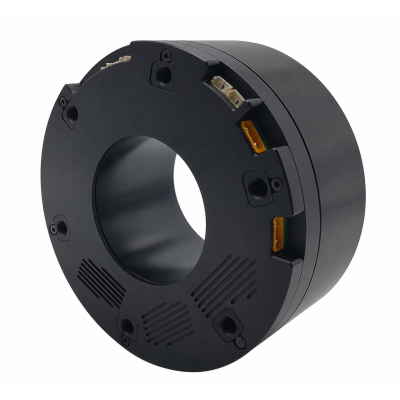
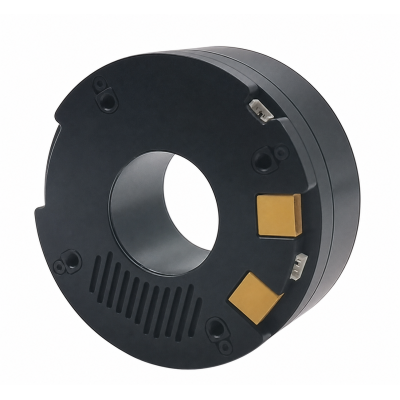
A hollow-shaft (through-bore) motor lets power cables, communication wires, optical fibers, and pneumatic lines pass through the rotation axis. This keeps wiring clean, prevents cable twisting and pulling during continuous rotation, and simplifies the mechanical layout of multi-axis arms. Hollow bores range from about 16 mm on compact joints to 50 mm or more on large waist joints.
If your robot uses continuous rotation joints or needs to route multiple cables through the axis, a hollow-shaft motor is almost always the right choice. It also reduces the risk of cable fatigue failure, which is one of the most common field issues in robotic systems.
4. Check the Communication Interface and Control Mode
The motor must speak the language of your controller. Common interfaces for joint motors include CAN / CAN FD, RS485, TTL, and PWM. CAN FD is widely preferred in multi-joint robots because it supports high-speed, real-time communication on a shared bus with simple wiring. Confirm that the motor supports the control modes you need: position, speed, and current/torque closed-loop control.
Also check the operating voltage range (for example 24–48 VDC). Matching the motor's voltage range to your existing power architecture avoids adding extra converters and simplifies system integration.
5. Evaluate Size, Weight, and Integration Level
In robotics, every gram at the end of an arm multiplies the load on the joints closer to the base. Integrated joint motors, which combine the motor, driver, and encoder in one housing, reduce external control boards, brackets, and wiring. This makes the joint lighter, easier to assemble, and more reliable.
Compare the torque-to-weight ratio rather than raw torque. A motor that delivers 1 N·m at 420 g may be a better fit for a lightweight arm than a heavier motor with more torque. Also consider axial thickness: flat, pancake-style hollow-shaft motors fit well into space-constrained joints.
6. Verify Protection, Noise, and Environmental Ratings
Joint motors operate in demanding environments. Check the ingress protection (IP) rating for dust and moisture resistance — IP54 is a common baseline for robot joints. Working temperature range matters for outdoor or high-temperature applications. Low operating noise (for example below 50 dB) is important for service robots, medical devices, and laboratory equipment where noise disturbs users.
Quick Comparison Guide
Frequently Asked Questions
Should I choose a direct-drive motor or a geared motor?
Direct-drive joint motors eliminate gearbox backlash, friction, and gear noise, and simplify the mechanism. They are ideal for precision positioning and quiet operation. If your application needs very high torque at low speed and weight is not critical, a geared solution may be considered, but direct drive is increasingly preferred for modern humanoid and collaborative robots.
Does higher encoder resolution always mean better accuracy?
Not by itself. Encoder resolution sets the finest position step the system can measure, but real accuracy is limited by mechanical stiffness, bearings, and control tuning. Choose a resolution that matches your required repeatability, then verify the complete system.
How important is the hollow bore size?
Very important if cables or tubes must pass through the axis, especially for continuous-rotation joints. Larger bores simplify routing but increase motor size and weight, so select the smallest bore that fits your wiring needs.
Final Thoughts
Selecting a robot joint motor is a balance of torque, precision, integration, and environment. Define your duty cycle honestly, match the encoder to the required accuracy, prefer integrated hollow-shaft designs for clean cable routing, and verify the communication interface and protection rating against your system architecture. If you are still comparing options, browse our robot joint motor range or contact our engineers with your load and speed data — we can help you shortlist the right model.